
B o r d e r s & B o u n d a r i e s



Charcoal


Oil
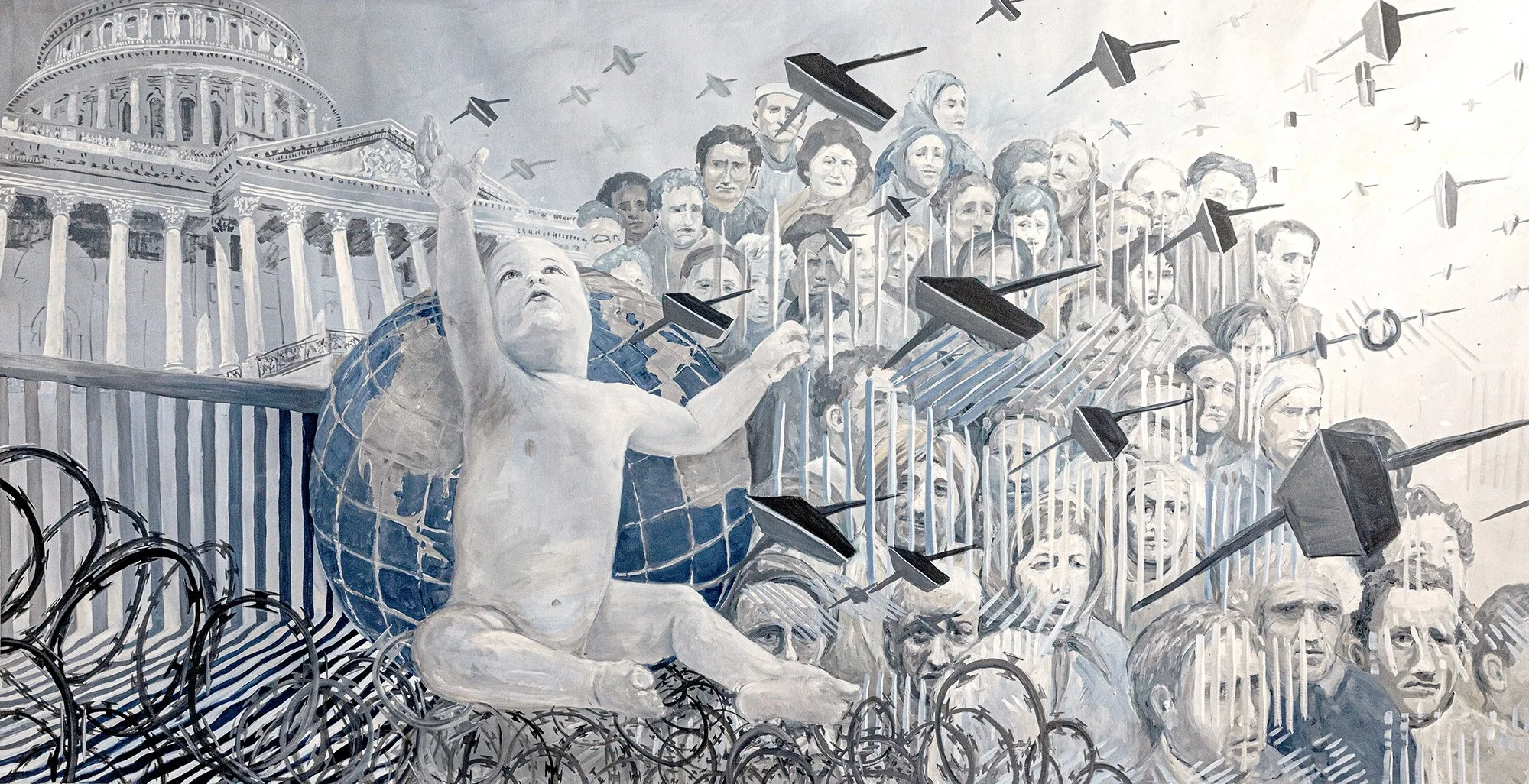
Oil Sketch: Her Inheritance. 48x97 inches. Oil on Raw Canvas. Unframed
Mixed Media

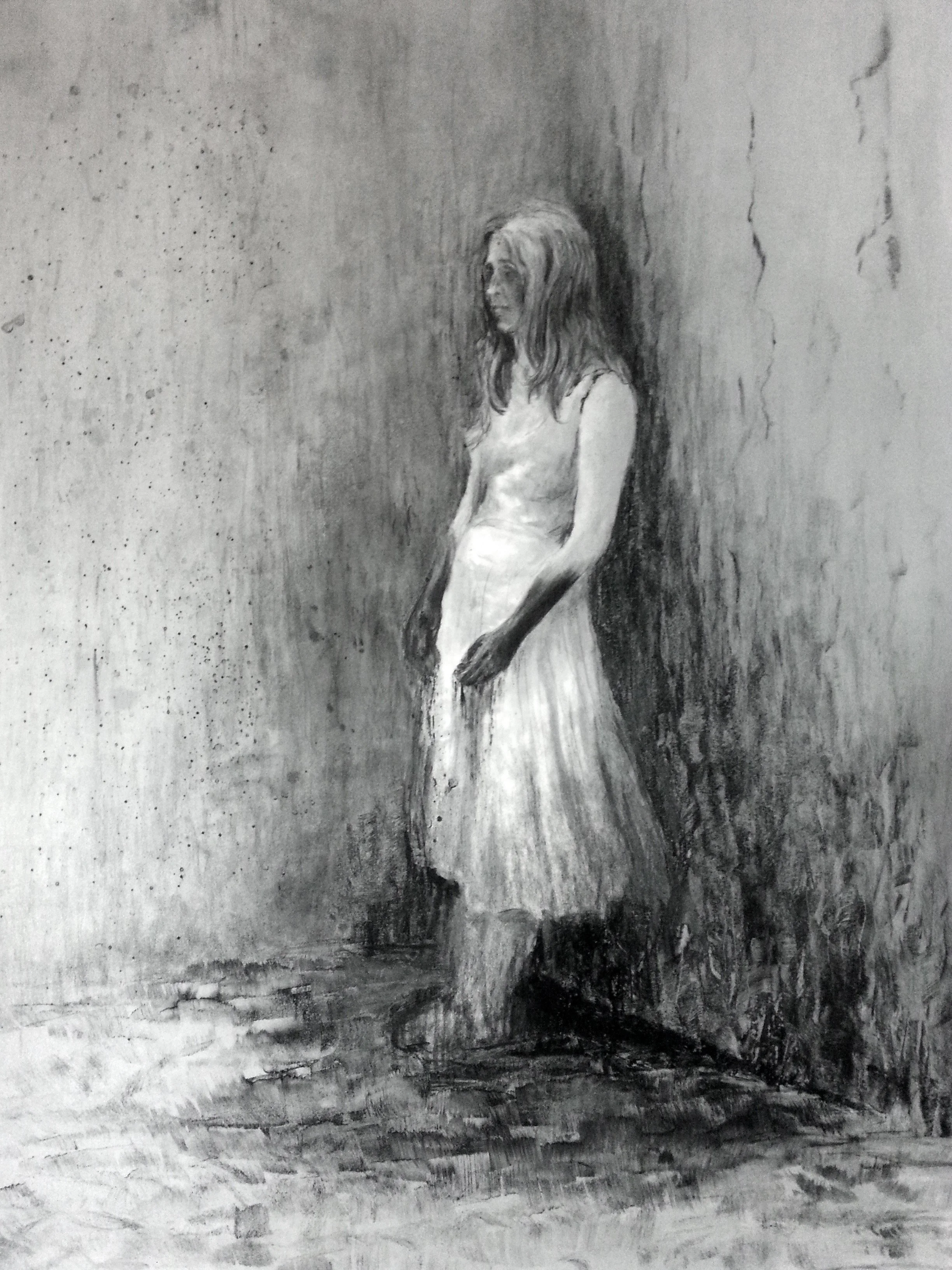

Click below to hear Colin Bell read his poem,
“Aleppo” written in response to the drawing
”Collateral Damage”
Fiber
Long Hours, Hard Work, 1920
17.5 x 24 x 1.5 inches. Cotton threads stitched on linen blend fabric, polyester batting, ink, needles, pins,
and historic immigration ephemera reprinted on cloth.
NOTE: The above artwork has been sold, but may be available on loan
Out of Reach
30x24 inches. Cotton threads on linen blend fabric printed with digitally altered photographs, metal rabbit fencing, wood, battered glass and metal jewelry case, metal chains, and old metal keys.
About
-
The original solo exhibition, Borders & Boundaries was on view at Pleiades Gallery, 547 W 27th St. NY, NY 10001, June 11-July 6, 2024.
A new solo exhibition is set for October 4 - November 16, 2026 at The Shakespeare Theatre of New Jersey, 36 Madison Avenue, Madison, NJ 07940
Works from this series have also been shown in:· Social Justice at Gallery X, New Bedford, Massachusetts;
· NHAA Biennial, Portsmouth, New Hampshire;
· FALL OF FREEDOM: Freedom of Expression, a Women’s Caucus for Art (WCA) national online art exhibition;
· When in the Course of Human Events…, at the Bristol Art Museum, Bristol Rhode Island;
· National Association of Women Artists, Inc. 136th Annual Members Exhibition, Leonovich Gallery, NY, NY
-
In a program that combined artistic genres, selected poets created works written in direct response to individual artworks in the Borders and Boundaries exhibition. A live poetry reading took place on July 6, 2024.
-
As part of the exhibition Heather Stivison: Borders and Boundaries, Pleiades Gallery presented guest speaker historian Tyler Anbinder on June 15, 2024. Anbinder discussed his book City of Dreams: The 400 Year Epic History of Immigrant New York, while surrounded by Stivison’s works on the topic.
The book is described by the New York Times as “A richly textured guide to the history of our immigrant nation’s pinnacle immigrant city.”
The Boston Globe said "Told brilliantly, even unforgettably ... An American story, one that belongs to all of us."
Hear the recording of the dialogue between artist and historian
-
· OTHER
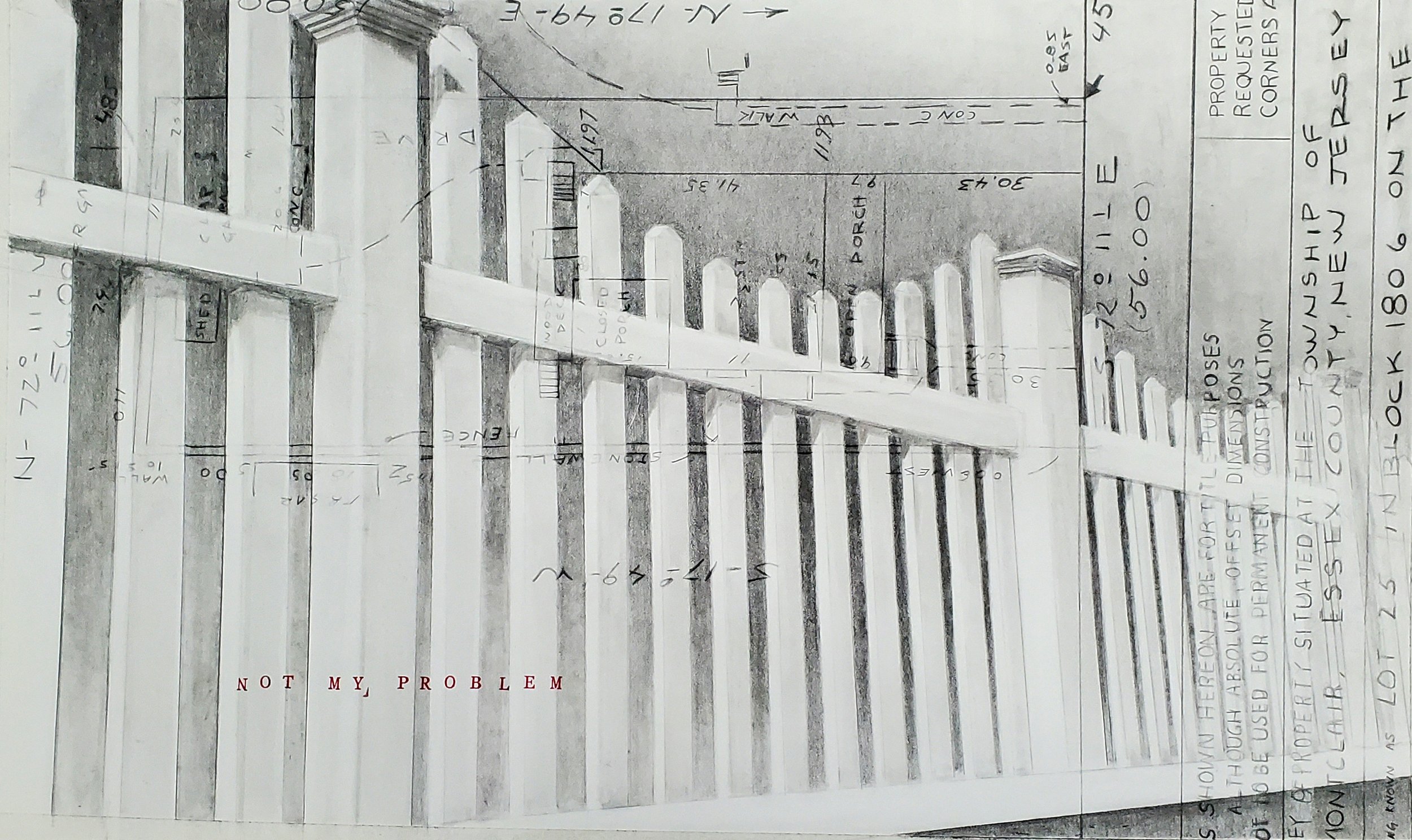
· NOT MY PROBLEM
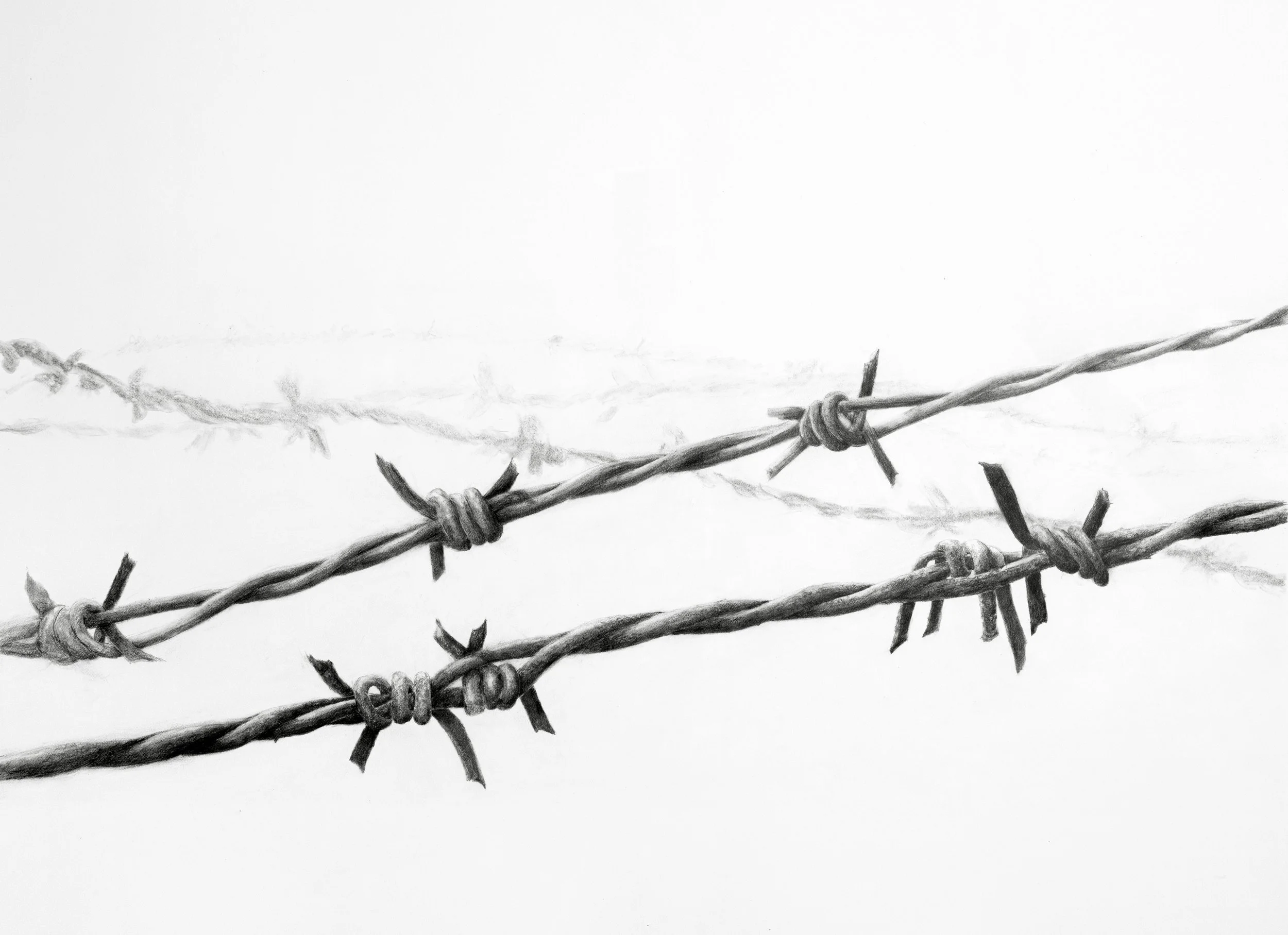
· LANDSCAPE OF FEAR
· NO WAY OUT
These four works are done almost entirely in pencil—a medium I usually associate with soft, gentle renderings—in stark contrast to the harshness of the subject matter. In choosing pencil, I ask you to look closer, pause, and think.
At first glance, the drawing may appear to be realistic, but the subjects have subtle variations. All the barriers are heftier than reality.
In Landscape of Fear the thickened barbed wire with faint rows in the distance creates a landscape-like sensibility.
In No Way Out, the razor-wire has grown pointy, with twisted edges to underscore its evil purpose.
In the award-winning work, Other, the chain-link fence has been altered to appear significantly thicker, sturdier, and with much smaller openings, in order to enhance the sense of impenetrability. I wanted to contrast the thick stiff metal with the softness of the human skin that touches it. This drawing was awarded the Elizabeth Morse Genius Foundation Medal of Honor Award by the National Association of Women Artists in 2025.
Paired with Other, the drawing Not My Problem, speaks of white privilege. In it, a simple picket fence sits on a background of a suburban home-buyer’s property map. Stamped across the fence, is the only non-graphite element in the series— small letters in red acrylic paint ask us to step closer and examine our own positions of privilege in society.
-
· TRACES
· STRANGERS IN A NEW LAND, 1905
These two charcoal and chalk drawings were made on wooden boards reclaimed from broken pallets and packing crates. The broken, rough strips were nailed together to create something new, just as broken lives put themselves together to create new lives. The old life is still evident. Not forgotten.
Traces—the image of a shadow cast by a contemporary woman seen through a chain link fence—is a memory of a place, a homeland, a society, and a culture that only exists in memories.
The contemporary narrative of Traces is paired with the historical narrative of Strangers in a Strange Land, 1905, where a woman and child wait in limbo on Ellis Island. They cannot be released from the holding area until they are claimed by a male relative. Then, their uncertain future in this strange new land will begin. -
More than eight feet wide, this oil painting hangs on the wall, unframed with paint-splattered raw edges.
Using a palette of warm and cool greys, I worked quickly, wanting a sense of immediacy rather than a carefully detailed overly realistic and resolved painting. This was my way of saying the story may be incomplete.
In my mind, the infant represents my own daughters and all the generations to come. What kind of world will they inherit? We are at an inflection point.
Despite the violence, hatred, and inhumanity we see in today’s world, we have within us, the power change courses and leave a better world for our children.
-
· LONG HOURS, HARD WORK, 1920
· OUT OF REACH
Both of these works began as drawings of people I know. The drawings were digitally reworked before printing onto a linen blend fabric.
In Long Hours, Hard Work, 1920, the textile material and the stitching are a direct reference to “women’s work” and specifically to the immigrant women who toiled in New York City’s garment industry during that time in history. The woman’s face was first embroidered with a subtle range of grey-blues, greens, and violets. And then, the artwork sat, unfinished for a very long time, as I folded and refolded the fabric, cropping it different ways, adding and subtracting other collage elements. I hung it on the wall, making changes over and over, waiting for it to “speak” to me, to say what I had in my heart. It wasn’t until I inserted the irregular rows of sharp steel pins that the work came alive for me. The rest of the work—the immigration ephemera, the bits of thread and needles, all fell into place.
Out of Reach began using the same methods as Long Hours, Hard Work, 1920, although in this work the embroidery on the figures mainly highlights the edges.The images are obscured, hard to see. Looking closely, the viewer can see images of my own family’s life—something that probably seems fairly ordinary. We take these things for granted. In the center, a couple is married. They live in a romantic home. They are surrounded by children/grandchildren who are free to choose the directions their lives will take.
Heavily embroidered in black is the classic opening phrase for a fairy tale “Once Upon a Time.” The entire embroidery is obscured by a thick metal barrier, making the stitching and soft textile background impossible to touch, and even hard to see. Hovering overhead is a gold and glass box. It is locked and wrapped with chains. Barely visible inside the box are two unattainable house keys.
-
Although these four drawings focus on Ukraine, they apply to the innocents in all border wars. Using the same model, the drawings refer to losing a place of home, of sanctuary, of safety, and of peace.
And once again, there is the reminder of our own lives of privilege, where we observe this pain through the barrier of a digital screen that we can turn off at will.